Home Blog & Media The future of financial sustainability starts with trust, not just funding

The future of financial sustainability starts with trust, not just funding

November 10, 2025

Share this Post

Author

Aisha Tambajang

Senior Program Manager, The Gambia

Across the global development sector, the conversation on financial sustainability is expanding—beyond funding models to how systems evolve, collaborate, and stay resilient.

Resilience today means having the systems, leadership, and partnerships adapt in the face of constant change, not just surviving funding cuts, but finding new ways to stay effective through uncertainty.

That mindset framed our recent Humentum webinar, “From Surviving to Thriving: Rethinking Financial Sustainability”, where leaders and practitioners from across civil society unpacked what it truly means to operationalize sustainability in practice.

The discussion built on insights from the Weaving Resilience Initiative — a Ford Foundation program delivered by Humentum that helps civil society organizations (CSOs) across Southern Africa strengthen governance, financial systems, and leadership capacity.

(Download this flyer for a quick overview of the program)

Resilience in a Changing Landscape

Everywhere you look, organizations are being asked to do more with less — to stay agile amid shrinking budgets, shifting donor priorities, and growing compliance requirements. Findings from Humentum’s 2024 CSO Resilience Index, which surveyed 220 organizations across 60 countries, makes this reality clear. While most CSOs identify financial sustainability as a top priority, only one in three holds financial reserves or multi-year plans. Restrictive funding, limited overhead coverage, and compliance-heavy grants continue to undermine long-term capacity.
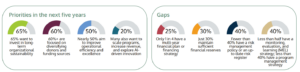
Yet, resilience is possible, and already taking root. Across regions, organizations are experimenting with cost-recovery models, diversified income streams, and peer-learning structures that build capacity from within. These are exactly the strategies being amplified through Weaving Resilience, reshaping how sustainability is understood and practiced across the sector.

What We’re Learning from Weaving Resilience

Since its launch in 2022, the Weaving Resilience Initiative has supported hundreds of organizations as they move beyond short-term fixes to embed sustainability into their core systems, and way of working.

In 2025 alone, the Southern Africa Hub exceeded its goals, engaging over 200 organizations and 100 leaders through communities of practice focused on systems thinking, leadership accountability, and adaptive planning. These results echo the broader trend across Humentum’s programs, where partner organizations report measurable progress, including:

  • 206% improvement in financial sustainability
  • 85% stronger monitoring, evaluation, and learning (MEAL) systems
  • 62% gains in leadership and governance capacity

This impact is reflected in the experiences of partners like FAWEZI, whose Senior Programme Officer, Nqobile Nkiwane, shared:

Designing the financing strategy was most helpful as it helped us in developing plans to meet our financial goals and implementation of long-term objectives. Also, being given the push to work as a team to develop our own plan and policies.

Nqobile Nkiwane, FAWEZI

These engagements reveal a shared truth: sustainability is not a checklist — it’s a mindset. Organizations that integrate financial resilience into leadership and governance are the ones that thrive long after donor support ends.

Weaving Resilience also shows that sustainability is not solitary work.c It requires an ecosystem where funders, partners, and practitioners move beyond transactions toward shared purpose and lasting commitment.

A Systemic Approach, Not a Single Intervention

Resilience cannot be built in isolation. It depends on the interconnected systems that link funders, CSOs, INGOs, and the communities they serve. From our work and recent dialogues, three key shifts are essential:

  1. Funders must invest in systems, not just outputs. 
    Flexible, multi-year funding builds trust and enables organizations to plan, learn, and innovate beyond short-term deliverables.
  2. CSOs must treat sustainability as strategic, not reactive. 
    It should be embedded in planning and governance, linking financial decisions to mission outcomes and leadership accountability.
  3. Intermediaries like Humentum must connect the dots. 
    Our role is to bridge funders and implementers, providing the tools, learning, and accompaniment that align both sides around shared goals.

This tri-part model — flexible funding, strong systems, and connective intermediaries — is what form the backbone for lasting change.

Building a Culture of Resilience

When organizations are supported to lead their own transformation, sustainability becomes part of their culture. Through workshops, mentorship, and peer learning, Weaving Resilience participants are redefining how they relate to risk, power, and accountability. Across Africa, more than 375 social justice organizations have already implemented mission-aligned governance structures and multi-year financial strategies through Humentum-led programs, showing that cultural change is both possible and scalable.

For many, resilience now means:

  • Planning beyond the project cycle
  • Building reserves to manage uncertainty
  • Ensuring fair pay, inclusive practices, and staff wellbeing
  • Strengthening community trust through transparent governance

These are the foundations of locally led, lasting development.

A Call to Rethink, Rebuild, and Reimagine Together

The future of development will depend on how we respond to this moment. The data is clear: financial fragility is widespread, but it is not permanent. What organizations need are trusted partners who understand the realities of the ecosystem and can turn insight into strategy.

Weaving Resilience proves what’s possible when those conditions come together; when funders invest flexibly, CSOs lead confidently, and intermediaries build bridges — sustainability becomes not just possible, but inevitable.

The Bigger Picture: Humentum’s Role

At Humentum, we work alongside over 1,500 social good organizations as a global partner and trusted guide. Our focus is o strengthening operating models — the systems, structures and processes that allow organizations to take ownership of their missions, people, funding, and risk.

We do this through membership, training, consultancy, and community engagement, creating practical pathways for organizational resilience and lasting financial sustainability. Whether through initiatives like Weaving Resilience, the TIME Initiative, or our Solutions Hub, our aim is simple: to help organizations strengthen from within.

In an era defined by uncertainty, this kind of resilience isn’t optional — it’s essential.

Find out how we can support your organization and partners